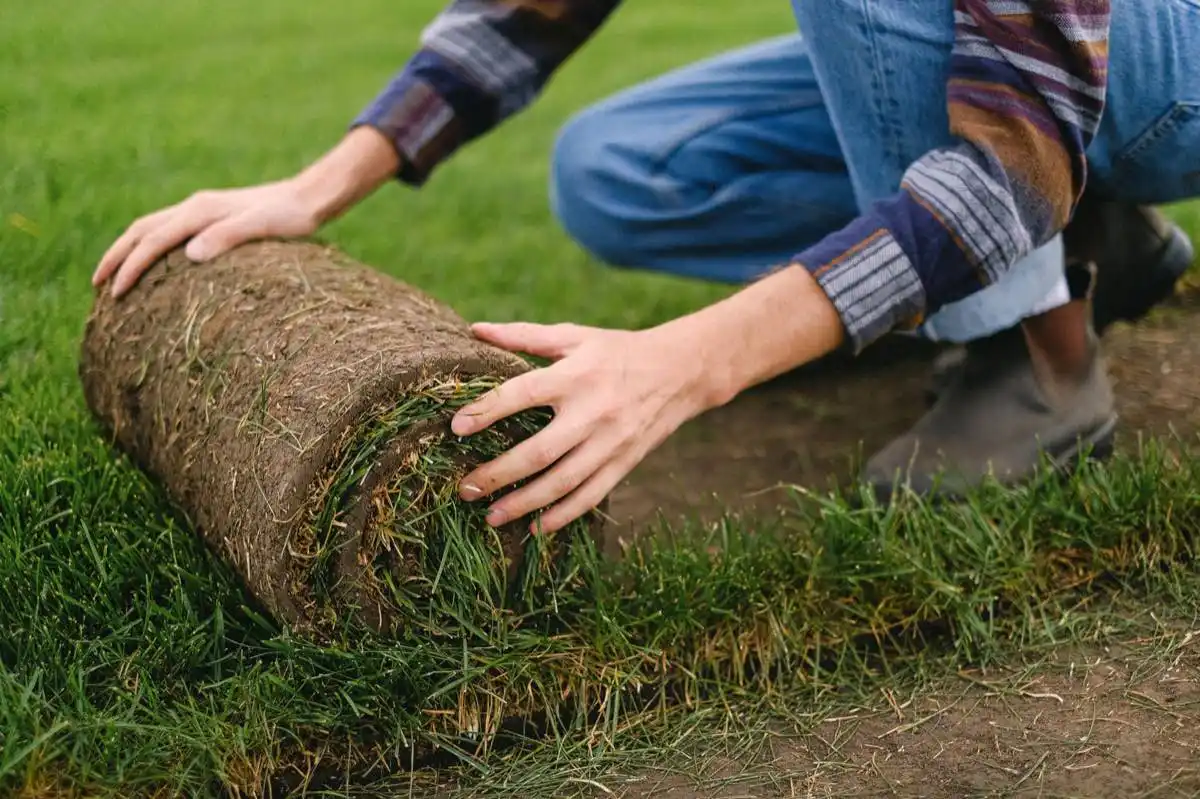
Seed costs about a fifth of what sod costs and takes about ten times longer to become a lawn. Sod runs $0.40 to $0.80 per square foot installed; seed runs $0.05 to $0.20 per square foot in materials. That gap is real, and it is also not the whole story.
The decision usually is not about money. It is about whether the grass you want even comes as seed, whether you have a slope, and whether you can tolerate three months of a yard that looks like a work in progress.
The comparison
| Sod | Seed | |
|---|---|---|
| Cost per sq ft | $0.40–$0.80 installed | $0.05–$0.20 materials |
| Lawn on day one | Yes | No |
| Walk on it | ~2 weeks | 8–12 weeks |
| Full establishment | 4–6 weeks | 2–3 months of growing season |
| Install window | Most of the growing season | Narrow, tied to soil temperature |
| Weed pressure during establishment | Very low | High |
| Works on a slope | Yes | Poorly |
| Grass varieties available | Whatever is grown locally | Far wider, if it seeds at all |
| Watering during establishment | Intense but short | Lighter but for months |
| Failure mode | Rare with proper water | Thin patches, common |
The point that settles a lot of arguments
Many of the best warm-season grasses cannot be grown from seed.
St. Augustine is not commercially available as seed at all — sod or plugs, full stop. The improved Bermuda hybrids that sports fields use, the Tifway and TifTuf class, are sterile and propagated vegetatively. Most named Zoysia varieties are the same.
So if you want any of those, the debate is over before it starts. Seeding limits you to common Bermuda, some Zoysia types with a slow and frustrating germination process, buffalo grass, and the cool-season grasses.
This is the fact that surprises most people mid-way through pricing a project.
Where seed genuinely wins
Large areas. The cost gap scales. On a quarter-acre, sod is a serious number and seed is a Saturday and a few hundred dollars in materials. Below about 3,000 square feet, the difference matters much less than people expect.
Grass variety choice, in the cool-season world. Fescue blends in particular give you options sod farms do not carry.
Patching and overseeding an existing lawn. Nobody sods a bare patch.
A yard you are not in a hurry about, and where the timing lines up with the right seeding window for your grass.
Where sod genuinely wins
Slopes and erosion. Seed on a slope becomes a green stripe at the bottom of the hill after the first real rain. Sod holds soil the moment it is laid and pinned.
Weed suppression. This is underrated. Bare soil for eight weeks is an open invitation, and you cannot use most pre-emergent herbicides because they would stop your grass seed too. Sod covers the ground immediately, so the weeds never get their window.
Timing flexibility. Seed has to go down when soil temperatures are right, which is a narrow window twice a year for most grasses. Sod can go down through most of the growing season.
Certainty. Sod either roots or it does not, and with proper watering it roots. Seeded lawns come in patchy, and the follow-up reseeding is a normal part of the process rather than a failure.
Dust, mud, and living with it. Two months of bare soil next to your front door is worse than it sounds, especially with kids or dogs.
The cost gap, more honestly
Seed's material advantage is real. What people forget to add:
- Water for two to three months instead of two to three weeks, over a much larger area of bare soil
- Weed control during establishment, and often a follow-up season of it
- Reseeding the thin areas, which is normal rather than exceptional
- Straw or an erosion blanket on anything with slope
- Time. Not free, if the yard is unusable for a season
A DIY seeded lawn done thoughtfully still comes in well under sod. Just not five times under.
Our recommendation
Sod if: the area is under about 5,000 square feet, there is any slope, you want St. Augustine or an improved Bermuda hybrid, the yard gets used, you are selling, or you want it done rather than in progress.
Seed if: the area is large, the budget is the binding constraint, you have the right seasonal window, the ground is flat, and you genuinely do not mind two or three months of the yard being a project.
And here is the honest version nobody selling either one will say: sod the front, seed the back. The front yard is what you and everyone else look at, it is usually the smaller area, and it is where instant results are worth paying for. The back is bigger, less scrutinized, and a fine place to spend $150 on seed instead of $2,000 on sod. We have suggested this split on plenty of quotes and it makes people happier than either extreme.
The thing that decides it either way
Soil preparation. Sod on bad soil fails. Seed on bad soil fails harder, because seed arrives with nothing — no inch of farm topsoil underneath it, no root plate already built, nothing to live off while it works out what it landed on.
The sequence is the same either way, and it is laid out stage by stage in our guide to preparing a yard for sod: the grade rule, the depth, the amendment, the starter fertilizer. Read it as the seeding guide too.
Two places the methods part company. Surface fineness — sod tolerates a slightly rough final rake because it bridges small hollows, and seed does not, so every clod you leave is a bare spot in six weeks. Rake finer for seed than you would for sod. Cover in the meantime — sod shields the ground the hour it goes down, while a seedbed sits open for weeks, so anything with slope wants straw or an erosion blanket that a sodded yard never asks for.
Skimp there and you have bought an expensive way to grow weeds.
When you do not need us at all
A flat back yard under 2,000 square feet, in the right season, with decent existing soil, is a straightforward DIY seeding project. Rent a slit seeder rather than broadcasting by hand — seed-to-soil contact is the whole game — keep the top half inch damp for two to three weeks, and be patient.
Call someone when there is grading to fix, drainage problems, a slope, heavy clay or new-construction fill, or an area big enough that hand work stops making sense.
Elk Grove Elite Sod & Turf is a sod outfit, so weigh the recommendation accordingly — we will still tell you when the back yard ought to be seeded. What we do in Elk Grove and the Sacramento Valley is warm-season sod, soil prep and grading, which is the half of the job that decides whether either method takes. For pricing, see our sod installation cost guide or our grass type comparison.
Get a free quote → · call (877) 679-5932
Ready for a free quote in Elk Grove?
Elk Grove Elite Sod & Turf — free estimate, clear scope, no pressure. Use the form on this page or jump to the homepage quote.
Related services in Elk Grove
Elk Grove Elite Sod & Turf money pages — go straight to the service you need.
- Bermuda Sod →
Bermuda sod is the water-budget answer for a full-sun Elk Grove yard, using substantially less irrigation than tall fescue once established and repairing its own wear as it spreads. We install TifTuf and Tifway 419, and the honest catch is winter color: Bermuda goes dormant and straw brown from roughly November to April here, and you need to be at peace with that before you buy it.
- Land Grading & Leveling →
Elk Grove Sod Pros handles land grading for Sacramento-area lawns where clay soils and winter rain punish bad drainage. Valley clay holds water and then bakes hard.
- Topsoil & Soil Amendment →
Topsoil and soil amendment is what you are really buying when you buy a lawn, because the top six inches decide almost everything that happens afterwards. Elk Grove sits largely on San Joaquin series soil, California's official state soil, and its defining feature is a cemented hardpan somewhere between roughly eight inches and three feet down that roots will not cross and water will not drain through.
- Tall Fescue Sod →
Tall fescue sod is the Sacramento Valley default and the grass most Elk Grove homeowners actually want, because it holds color twelve months a year instead of going straw brown from November to April. We install turf-type tall fescue and dwarf fescue blends across Elk Grove, and we will tell you upfront what that year-round green costs you at the meter.
- Zoysia Sod →
Zoysia sod is what Elk Grove homeowners buy after a few summers of feeding, mowing and watering a fescue lawn and deciding there has to be a better arrangement. It grows slowly, so you mow less, and it grows densely, so it crowds out most weeds without a chemical program propping it up.
Frequently asked questions
Is sod or seed cheaper?
Seed, by a lot on materials — roughly $0.05 to $0.20 per square foot versus $0.40 to $0.80 installed for sod. The gap narrows once you count the extra irrigation, the weed control through establishment, and the reseeding most people end up doing on the thin spots.
How long does seed take to look like a lawn?
Germination takes one to three weeks depending on the grass, and a genuinely full lawn takes two to three months of growing season. Sod is a lawn the day it is installed and is rooted enough to walk on in about two weeks.
Can you seed St. Augustine grass?
No. St. Augustine is not commercially available as seed and has to be established from sod or plugs. Most improved Bermuda hybrids are the same — they are sterile and propagated vegetatively. If you want those grasses, the sod-versus-seed debate is already settled.
Is sod better than seed on a slope?
Considerably. Seed on a slope washes into a stripe at the bottom with the first heavy rain, and you reseed. Sod holds the soil the moment it is pinned down, which is why erosion control jobs use sod almost exclusively.
Does sod root as deeply as seeded grass?
Eventually, yes. A seeded lawn develops its root system in place, which some people argue gives a slight early advantage. Two seasons on, a properly installed and watered sod lawn is indistinguishable underground. Soil preparation matters far more than which method you used.
Can I overseed a thin lawn instead of sodding it?
Often yes, and for turf that is thin rather than dead it is usually the right call. Overseeding with a slit seeder works into what is already there and costs a fraction of a tear-out. Sodding earns its price when the existing lawn is the wrong grass, is more weed than turf, or has to come up anyway for grading.
Local context
How this applies in Elk Grove, CA
Every article here is written from sod installation work done in Elk Grove and the Sacramento Valley, so the numbers reflect local labour, permit and material costs rather than a national average. Your own job can land either side of them depending on access, the condition of what is already there, and the materials you pick — turf-type tall fescue sod, dwarf fescue blends, TifTuf Bermuda.
The way to turn any of this into a real answer is to have someone look at your actual situation. The free estimate is free, itemized and written down, with no deposit and no obligation. Call (877) 679-5932 or start on the Elk Grove Elite Sod & Turf homepage.
Areas Elk Grove Elite Sod & Turf covers
Elk Grove first, then the surrounding communities of the Sacramento Valley. Each has its own page with local detail rather than a copy of this one:
- Sacramento, CA — Sacramento County, population 524,943
- Rancho Cordova, CA — Sacramento County, population 79,332
- Folsom, CA — Sacramento County, population 80,454
- Citrus Heights, CA — Sacramento County, population 87,583
- Galt, CA — Sacramento County, population 25,383
- Lodi, CA — San Joaquin County, population 66,348
Or jump to the full list of Elk Grove services.
More from the Elk Grove Elite Sod & Turf blog
- Sod Installation Mistakes in Elk Grove Yards
Sod installation mistakes that kill lawns in Elk Grove, CA — pallets left overnight, aligned seams, and the watering error nobody admits.
- Buffalo Grass Sod Pros and Cons for Elk Grove Lawns
Buffalo grass sod pros and cons in Elk Grove, CA — the lowest-water lawn grass there is, and where Bermuda wins instead.
- How to Prepare a Yard for Sod in Elk Grove (So It Roots)
How to prepare a yard for sod in Elk Grove, CA — killing the old lawn, the grade rule, tilling depth, and the day-before checklist.
The Elk Grove Elite Sod & Turf Team
sod installation specialists serving Elk Grove, CA
Written by the Elk Grove Elite Sod & Turf team — insured sod installation pros with 20+ years serving Elk Grove, CA and the surrounding area.